College
Savings Plans:
I
have pulled information together from several articles…so…sit back and prepare
to be amazed.
Next
to saving for retirement, your biggest financial challenge is probably saving
for your kids' college education. How do you know how much to save? How much
will a college education cost when Junior turns 18? What if you save all of
this money and then he decides to tour
Now,
in addition to the Coverdell Education Savings Account,
there is another way to save that can provide even better benefits. A 529
college savings plan is a very simple way to save money for your kids' (or anyone
else's) college education. The benefits are tremendous. Here are some of the
heavy hitters:
- You pay no taxes on the
account's earnings.
- The child doesn't have control
of or access to the account -- you do.
- If the child doesn't want to go
to college, you can roll the account over to another family member.
- Anyone can contribute to the
account.
- There are no income limitations
that might make you ineligible for an account.
- Most states have no age limit
for when the money has to be used.
- If the child gets a
scholarship, any unused money can be withdrawn without paying any penalty
(just the tax).
And
there are still more benefits.
In
this article, we'll look at the rules for 529
The Cost of College
If
you have small children and haven't been told how much a college education is
going to cost in 15 years, then you should make sure you're sitting down when
you read this. Conservative estimates put four years at a public (yes, public)
university in 15 years at about $100,000 or more. Try this calculator to find out how much it
will be for other time periods.
You
may never have thought you could get excited about big sums of money you won't
be spending on yourself until you read about this new college savings plan. The
529 plan may well be the best thing in college savings plans since... well,
anything. This plan offers the most painless way to save money for higher
education to date. And if the child decides not to go to college, you can roll
it over to someone else in the family that does want to go, including
yourself! The benefits of this plan far outweigh any drawbacks it may have --
which aren't many. Let's look at how it works.
The 529 Plan
The
529 Plan (named after its section number in the IRS code) is a savings plan for
college education. You have a couple of options when you open an account.
- One option lets you
prepay tuition at a qualified educational institution at today's tuition
rates (see below).
- Another option lets you save
money in a tax-deferred account (earnings only) to be used to pay for
education at future tuition rates.
The
idea, with either option, is that the investment earnings will grow to meet the
higher costs of future education. The savings account option is typically
considered the more attractive of the two and is what we will focus on in this
article.
The
529 plan is a state-sponsored investment program. That is, the state
sets up the plan with an asset management company of its choice, and you open a
529 account with that asset management company according to the state's
predetermined plan features. You are the owner of the account, and the child
for whom the account is set up is the beneficiary. You won't deal directly with
the state, but rather with the asset management/investment company.
State-to-State Variations
Because
each state can control some of the features of its own plan, there are
variations from state to state. Most plans follow the same general scheme (and
federal requirements), but make sure you compare plans among states other than
your own. Most states don't require residency in order to participate, so shop
around different states for the best deal. Click here for information that
will help you compare states and choose the right plan.
In
the next section, we'll look at some of the things that make the 529 plan so
attractive.
|
Prepaid Tuition
Option With the prepaid tuition option, parents, grandparents and
anyone else can lock in today’s tuition rates, and the program will pay
future college tuition at any of the state’s eligible colleges or
universities. The program will also pay an equal amount of money to private
or out-of-state institutions. You will usually deal directly with a state agency when setting
up a prepaid tuition plan. You buy tuition units (or years) either with a
one-time lump sum purchase or monthly installments. If you opt for the
prepaid route, then that money is pooled with other prepaid sums from other
account owners and invested by the program in order to grow to meet (or even
exceed) future tuition needs. The prepaid tuition account also works differently in regard to
eligibility for financial aid. The money paid
out from the prepaid tuition 529 account offsets the eligibility for
financial aid dollar-for-dollar. In other words, if your prepaid tuition
account pays $10,000 for tuition one year, then your child will be seen as
needing $10,000 less for financial aid. |
The Benefits: Tax Treatment
- All of the account's earnings
are exempt from federal tax when they are withdrawn if they are
used for qualified education expenses. This means that, unlike the taxes you have to pay on
earnings from regular stock investments, you won't
pay any tax on the 529 account earnings unless you end up using the money
for something other than higher education. Earnings are currently
tax-deferred in most states, as well.
- A break on the earnings tax
isn't the only tax advantage, either. Although your contributions aren't
pre-tax (you pay state and federal tax on the money you put into the
account), there are some states that let you deduct a portion of
your contributions from your state taxes. More states will probably follow
suit in the coming years.
|
Exemption The tax exemption on 529 account earnings is in effect at least
until 2011, which is when it can revert to the original plan where the
earnings are taxed at the child's rate. It is very likely that Congress will
revisit the 529 issue and vote to make the tax-free status permanent prior to
that date. |
The Benefits: Account Control
- Unlike
custodial accounts or Education Savings Accounts (ESAs,
formerly Education IRAs), the beneficiary does not gain control of the
money at a specific age (usually 18 or 21 for those types of accounts).
The account owner always has control of the money. This helps lessen that
parental anxiety that Junior will take the money and tour
- There are no
restrictions on who can open an account for whom. You can open an account
for your child, a friend's child, a relative, the paper boy, or even
yourself.
- Anyone can
contribute to the account. Now all (or at least some) of that birthday
money from Grandma and Grandpa that's usually blown on candy and
soon-forgotten toys can be funneled into the college savings account!
|
|

The Benefits: Income Eligibility
- Did you know that with an ESA,
you aren't eligible to contribute if you make more than $110,000 per year
($220,000 for married couples)? Unlike ESAs,
your income does not affect your eligibility to open a 529 account.
- Contributions to 529 plans also
qualify for the $11,000 ($22,000 for married couples in 2002) annual gift
tax exclusion. You can also contribute up to five years of gifts during
the first year, meaning you can put in up to $55,000 ($110,000 for married
couples). This is a great benefit in situations where inheritance money
enters the picture.
- Your account can grow up to
$268,000 in some states.
- You can contribute as little as
$25 to $50 per month.
The Benefits: How the Money Can Be Used
- In most states, there is no
age limit or time limit for when the money has to be used. Your child
can put off college indefinitely, in which case you have the option of
rolling the account over to another child as long as that child is in the
same family of the first beneficiary. In case you're wondering just who is
considered "family," the plan defines family members as
"the original beneficiary's spouse, children, sisters, brothers,
nephews, nieces, first cousins, and any spouses of those
persons."
|
|

- Your child can
go to any accredited degree-granting educational institution, whether it
is public, private, two-year, or four-year. There are even some
international schools that qualify.
- In most
states, qualified education costs include tuition, books, room,
board, transportation, and even computers.
- In the event
that your child gets a scholarship, then the remainder of the 529
account can be rolled over to another sibling (or relative), or it can be
cashed out with no penalty other than the tax paid (at your rate) on the
earnings. The same rule applies in the event of the child's death or
disability.
The Benefits: Investment Control
- If the thought of turning over
your hard earned money to the state makes you a little uneasy, rest
assured that the state doesn't control your money. In fact, most states
are signing on with well-known, successful investment companies such as TIAA-CREF, Vanguard and Fidelity. The number and
types of investment options vary by state, and once you select your option
you can't change it. You can, however, roll your money over
into another state's plan if you're not happy with your chosen investment
option. There is no penalty to roll the money over into another state's
plan, and you can do it once every 12 months. Most states have no
residence requirement for their 529 plans.
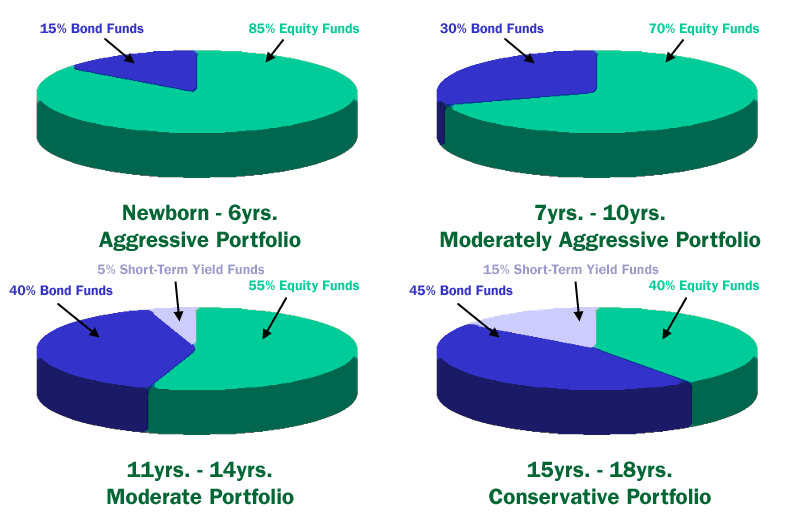
- Many plans are also offering
investment choices that are age-based. This means that if you're
starting early, perhaps when your child is age one to three, the
investments can begin aggressively in stocks then gradually shift to bonds
and money market accounts as your child gets closer to college age. Some
state plans offer several levels of options for aggressive, moderate and
conservative investments.
|
|
- If you can't
reach the risk level you want in one plan, you can always open a second
529 account in the same or another state. You can have as many accounts as
you want and can also contribute to both a 529 plan and an ESA. That way,
you can diversify your investments in the event that the plan
doesn't offer the investment mix you would like.
The Drawbacks
With
all of those pros, there have to be cons, but they're pretty acceptable and
easy to live with. Here they are:
- If your child
applies for financial aid, the 529
account may affect eligibility. According to FinancialAidOfficer.com:
...the 529 account is treated as an asset of the
parent or other account owner in determining eligibility for federal financial
aid. This means that your expected contribution towards your child's college
costs will include 5.6 percent, or less, of the value of your 529 account for
each academic year. This is actually much better than the 35 percent assessment
against money that is in your child's name or in a custodial account.
The only real drawback comes in when calculating
eligibility the second year. At this point, 50 percent of the money that was
withdrawn from the 529 account the first year shows up on your child's tax
return. This decreases your child's eligibility for the next year by 50 percent
of that amount. For example, if you withdraw $10,000 from the account to pay
for college expenses the first year, then $5,000 (50 percent of the total) will
show up as the child's taxable income. That will decrease your child's
eligibility the following year by $2,500, because there is a 50 percent
eligibility assessment on the child's tax return from the prior year. (Remember
-- we're talking about tax laws -- all of this can change.)
If the student owns the 529 account,
which is what happens when a custodial account has been transferred to a 529
account, then the amount of the account will greatly affect his or her eligibility
for financial aid. Because the student owns the account and it is one of the
student's assets, a 35 percent assessment against those assets kicks in.
- One thing to
watch out for is that the new tax laws regarding 529 plans will
"sunset" in 2011. This means that lawmakers will have to make
the tax change permanent before then or else the plans will revert to
their original tax-deferred status (see sidebar in previous section). This
possible reversal could affect you if your children will be going to
college after 2011.
- The money in
your 529 plan can't be used as collateral for a loan.
- You don't
control the investments (more about how the money is invested in the next
section). Your only option for changing the investments made with your
money is to roll the account over to another state's plan. You can do this
once a year with no penalty.
- If you have to
withdraw the money for some reason other than to pay for qualified higher
education, then you pay tax (at your rate) and a 10 percent penalty.
- You can only
make cash contributions to the account; stocks can't be rolled over into
it.
- Although you
are the account owner, 529 accounts are considered gifts and are,
therefore, not calculated as part of your own estate assets.
- Each
beneficiary must have his/her own account. Siblings or cousins can't share
an account. You can, however, roll any remaining portion of an account
over to another child once the account's beneficiary has completed
college.
Investment Control
If
you are investment-savvy, then handing over control of your 529 account
investments may be a difficult thing for you to do. If you're not quite so on
top of things in the investment world, however, you may find trusting your
money to a professional investment manager a little comforting. Remember that a
money management company is actually managing the investments. The state works
with those companies to set up your selection of investment options. The good
news is that some very well-known money management companies are managing many
state programs. Your comfort level may increase just knowing the reputation of
those handling your account.
The
choices you have for investing your 529 account funds are determined by the
investment manager of the plan. Many states are expanding their investment
choices, making it easier for most people to find a plan that suits both their
goals and their acceptable risk levels.
In
addition to mutual funds, most state plans are also beginning to offer several age-based
portfolios of mutual funds that include conservative, moderate, and
aggressive asset allocations. These types of investment choices start out in
stocks when your child is very young and shift gradually to bonds and
money-market funds as your child gets closer to college-age. The idea behind
the age-based portfolios is to be aggressive when you have more time, but to
keep your investment safer as it gets closer to the time that you need to cash
out. The perk behind this scheme is that you don't have to remember to shift the
investments yourself. You can buy it and then forget about it. In addition to
the age-based portfolios, you may have the option of 100-percent stock
and fixed-income funds that can be used alongside an age-based portfolio
in order to fine-tune the overall allocations to suit your needs.
If
you decide later on that you're not happy with the way your account is growing,
you have the option of rolling the money over into another
state's 529 plan with no penalty. Keep in mind that if you're getting a
state tax break by using your own state's plan then you'll lose that by moving
to another state's plan. You can always keep the account in your state and open
second account in another state. There is no limit to the number of accounts
you can have -- even for the same child!
Each
state has different investment options and this is a very important part of
setting up your plan. It pays to investigate several state's
plans in order to find the best deal not only for investment options but for
the other requirements and limitations of the plan. Let's go over the how to
pick the right plan...
Choosing the Right Plan
Choosing
the right 529 plan is not much easier than choosing anything else in financial
world. It takes some research, some luck, and the ability to accept some level
of risk. The variations in state plans don't make the process any easier. Here
are few guidelines that can get you started:
|
Researching 529 Plans The Kiplinger Web site offers
information about the best deals for 529 plans. SavingForCollege.com is also a
great resource for all kinds of information about 529 plans. It provides
state-specific information and links to state programs. |
- The first
thing to do is to look at your own state's plan. There are
currently 16 states that offer a tax deduction on 529 contributions,
and many that also exempt state tax on the earnings upon
withdrawal. Some states may offer matching grants or loan programs. This
can make a fairly significant difference and is worth weighing against
other state plans that may have lower fees.
- The next thing
to look at is the manager of the plan. Because the plans haven't
been around for very long, you can't really rely on the success record of
the plan manager. Look at the investment company's record of dealing with
mutual funds and pension plans.
- Next, look at
the fees the plan charges. Finding a low-cost plan means looking at
several possible charges. For instance, some states charge an enrollment
fee to open the account, and some also charge annual maintenance fees.
Then there is the expense ratio, which is the percentage of fund assets
that pays for operating expenses and management fees. This includes 12b-1
fees (basically, fund marketing fees), administrative fees, and all of the
other asset-based costs that the fund incurs, with the exception of
brokerage costs. Expense ratios often decrease as a fund gathers more
dollars from investors, because the fund’s managers can spread the fixed
costs of running the fund over a larger asset base. Expense ratios for 529
plans vary from a low of 0.31 percent to a high of 2.24 percent.
Additional costs can also be incurred with plans that are sold by brokers.
The commissions currently range from about 3.25 percent to 5 percent,
payable upfront! Usually, buying direct eliminates the brokers' fees.
- Look at how flexible
the plan is. You don't want to be penalized when you want to change
beneficiaries or roll the account over to another state's plan. You also
don't want to be limited in how the funds can be used. For example, most
states allow the funds to be used for all qualified education expenses
including the expense of books, housing, etc., as well as graduate school.
Look at the amount you will most likely have when your child enters
college and make the decision about whether the eligibility of those other
expenses will be an issue. For example, if you know you will only have
$20,000 in the account and tuition alone is $40,000, then whether the
money can be used for housing isn't relevant.
Another issue is the age limitation.
There are a few states that may require your child to use the money prior to a
certain age, or that may require that the child be under a certain age in order
for you to be able to open an account. There may even be limits to how long the
accounts can remain open without any withdrawals.
- Investigate
the availability and fees related to withdrawing your cash.
Although the IRS set a 10-percent fine for withdrawal of funds that are
not used for qualified education expenses, plans can charge more
than that. Also find out about how easy it is to get your money in the
event of an emergency. Sometimes, there are time requirements about how
long the money has to stay in the account before it can be withdrawn. If
you do have to withdraw a portion of the money for a non-education
expense, find out what happens to the rest of the account. Is it closed?
Is a fine charged for the entire amount?
- Look at the
maximums and minimums for contributions. Determine how much you
want to have in the account when your child enters college. Make sure the
plan allows at least that amount. You also may need a low minimum if you
want to start the plan out without a large sum of money.
- Find out what
happens with the ownership of the account if the account owner
dies. Does it go directly to the beneficiary? Or, do you have the right to
determine a successor? Also, check to see if you can change beneficiaries
with little hassle from either the plan or the current beneficiary.
- Finally, check
to make sure the plan is well managed and has the resources devoted
to it that it needs. Check for program materials that answer all of your
questions, good program support staff, and an easily navigated Web site
offering quick program information and access to information about your
account.
Custodial Accounts
Money
that goes into a custodial account is an irrevocable gift belonging to
the child. The advantages have been that putting money into the account lowers
the family's total taxable income, and that the first $750 in earnings are
tax-free and the next $750 in earnings are taxed at the child's tax rate
(usually around 10 percent). The disadvantages are that you can't take the
money back in the event of an emergency. The money can be used for the child's
benefit but not for your own or your family's (i.e., unemployment, vacation,
home improvements). You can probably get away with using the money that way,
but the child has the legal right to fight the decision. Another disadvantage
is that the child can spend the money on anything once he or she reaches either
18 or 21 depending on your state's age requirement. Financial aid eligibility creates
yet another disadvantage for custodial accounts because when the money is in
the child's name, then 35 percent of it will be considered an asset available
for college costs, possibly making the child ineligible for financial aid.
Converting
a Custodial Account to a 529
You can convert your existing custodial account to a
529 account, but it won't have the same benefits. The problem is that the money
in the custodial accounts belongs to the child and therefore will still belong
to the child when it is converted to the 529. That means that the child will
still gain control of the account at 18 or 21 and have the opportunity to cash
out (paying taxes and penalties) and then use the money for anything.
Education IRAs
Now
known as Coverdell Education Savings Accounts,
ESAs were improved significantly in 2002 because
Congress increased the annual contribution limit from $500 to $2,000. Like 529
plans, ESA earnings are tax-free when used for education expenses, and they are
considered the parents' asset so they don't adversely affect financial aid
eligibility.
They
do have some advantages over 529 plans, including more control over your investments
and the ability to use the money for private elementary or secondary school
expenses.
Their
disadvantages are the limitations on parents' income. For single tax
payers, the eligibility phases out for incomes between $95,000 and $110,000.
For married taxpayers filing jointly, eligibility phases out between $190,000
and $220,000. Another disadvantage is that the funds have to be used for
education by the time the beneficiary turns 30. Like the 529, there is a
10-percent penalty if the money is used for anything other than education
expenses.
For
more information on 529 plans and other college savings topics, give me a call
or email.